Diane Berg Consulting
  • Home
  • The Framework
  • The Book
  • Speaking
  • Consulting
  • Resources
  • About Diane
  • Contact
  • More
    • Home
    • The Framework
    • The Book
    • Speaking
    • Consulting
    • Resources
    • About Diane
    • Contact
Diane Berg Consulting
  • Home
  • The Framework
  • The Book
  • Speaking
  • Consulting
  • Resources
  • About Diane
  • Contact

why traditional growth models fall short

For decades, growth has been described as a ladder.


Move up.
Climb higher.
Reach the next rung.


The assumption has been simple: progress means upward movement — a better title, greater authority, more responsibility, more visibility, more status.


And for some moments in life, that kind of growth is real. But it is not the only kind.


The problem is that many people spend years believing growth only counts when it looks upward. As a result, they often misinterpret some of the most important developmental seasons of their lives.


A promotion may look like growth from the outside while internally creating burnout, disconnection, or misalignment.


Meanwhile, periods of reflection, recalibration, stability, reinvention, or grounding are often dismissed as stagnation — even when they are preparing someone for meaningful transformation.


Traditional growth models tend to fall short because they assume development is:

  • linear 
  • predictable 
  • upward 
  • visible 
  • externally measurable 


But real human growth is far more dynamic.


Sometimes growth means:

  • advancing into new opportunity 
  • stretching beyond comfort 
  • revisiting old lessons 
  • stabilizing after chaos 
  • rooting into identity and values 
  • transforming through disruption 
  • integrating competing priorities 
  • expanding perspective and possibility 


Growth rarely unfolds in a straight line. It moves in seasons, loops, transitions, tensions, pauses, accelerations, and reinventions. People do not fail because they stop climbing. Often, they struggle because they have only been taught to recognize one direction of movement.


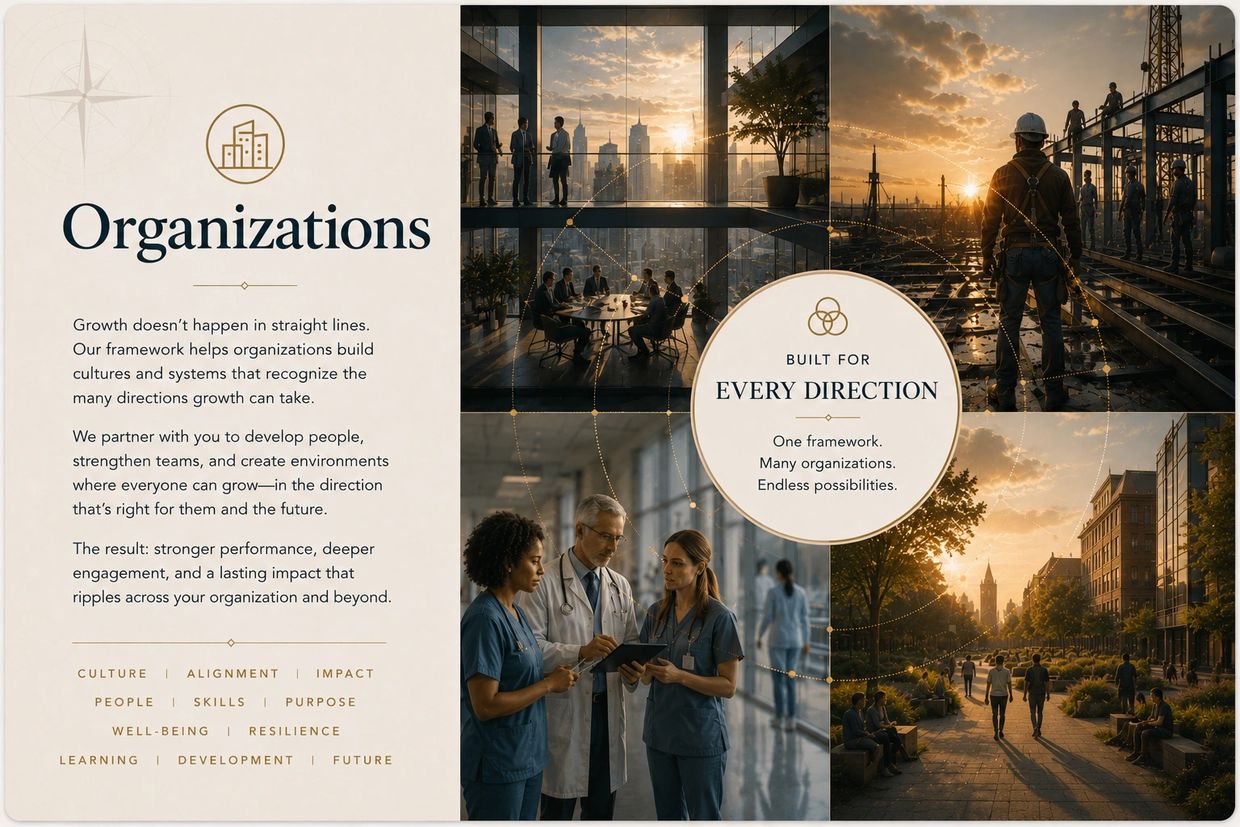
Organizations experience the same problem. Many systems reward only visible upward advancement while overlooking:

  • emotional development 
  • reflective capacity 
  • sustainable leadership 
  • reinvention 
  • strategic stabilization 
  • internal alignment 


This creates cultures where people feel pressured to constantly “move up,” even when another direction of growth may be more necessary, healthy, or transformative.

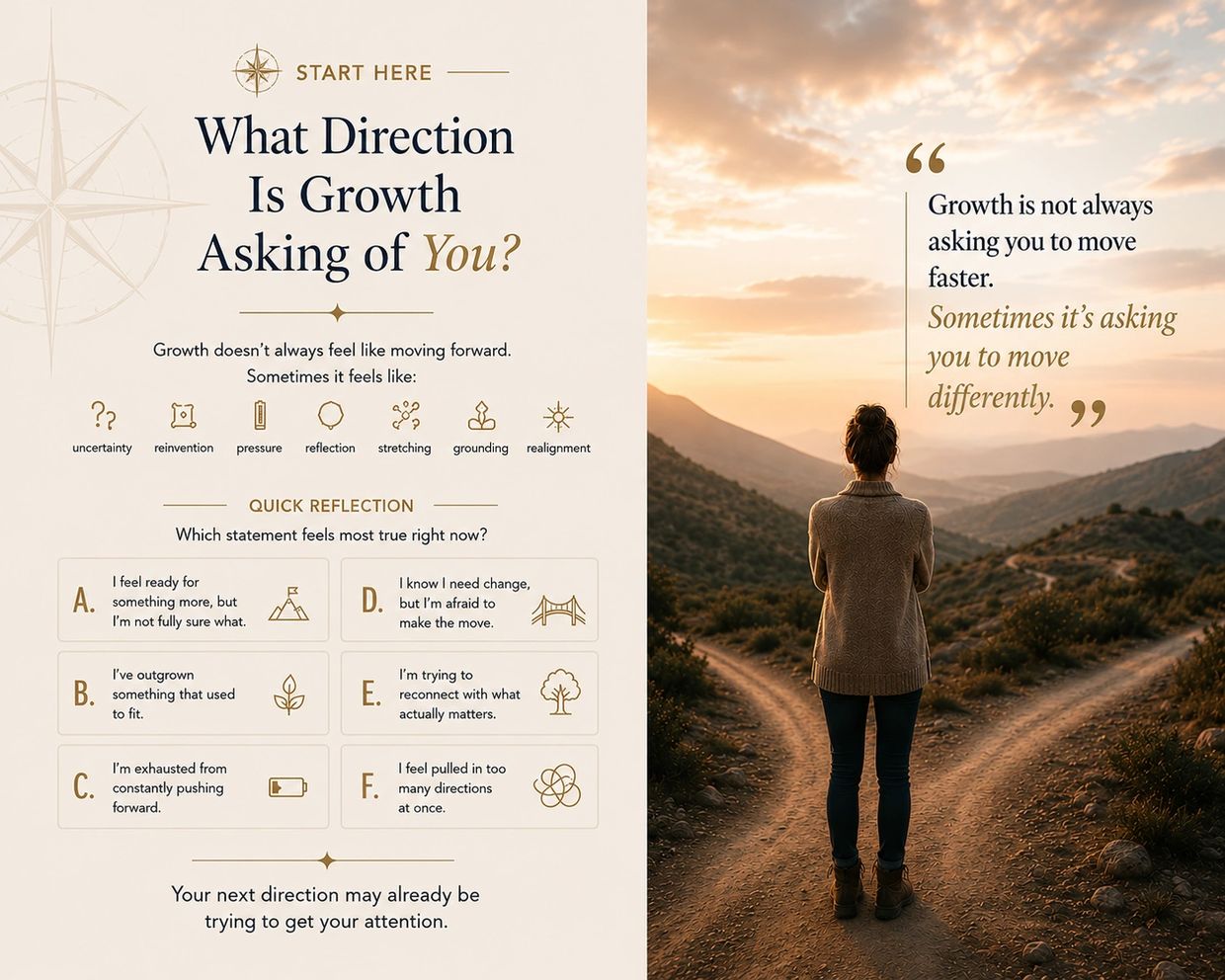
Directional Growth offers a different way to understand development.


Instead of asking: “How do I keep climbing?” The framework asks: “What direction is growth asking me to move right now?” That shift changes everything.

the nine directions

Elevate

Elevate

Elevate


Leadership perspective and responsibility.


  • Often feels like: Stepping back to see the bigger picture.

Advance

Elevate

Elevate

Forward momentum and progress.


  • Often feels like: Movement, ambition, and acceleration.

Expand

Elevate

Stretch

Exploration, curiosity, and possibility.


  • Often feels like: Discovery, experimentation, and new perspective.

Stretch

Transform

Stretch

Challenge, courage, and capacity.


  • Often feels like: Discomfort that leads to growth.

Transform

Transform

Transform

Deep change and reinvention.


  • Often feels like: Identity shifts and meaningful transition.

Root

Transform

Transform

Grounding in identity and values.


  • Often feels like: Returning to what matters most.

Revisit

Stabilize

Stabilize

Reflection, recalibration, and learning.


  • Often feels like: Look backward in order to move forward.

Stabilize

Stabilize

Stabilize

Balance, sustainability, and integration.


  • Often feels like: Creating steadiness and long-term health.

Integrate

Stabilize

Integrate

Intentional alignment and wise choice.


  • Often feels like: Bringing competing priorities into coherence.

Find out more

who the framework is for

Directional Growth helps people, leaders, and organizations navigate growth with greater clarity, alignment, and intention.

foundations of the framework

Directional Growth draws from multiple fields of human development, leadership, and organizational theory, including:


  • adult development 


  • adaptive leadership 


  • systems thinking 


  • coaching psychology 


  • reflective practice 


  • emotional intelligence 


  • organizational development 


The framework is designed to bridge practical leadership with the emotional realities of growth.

The goal isn't just to grow.

It's to grow in the right direction.
Explore the BookBring Directional Growth to Your organizationBook diane to speak

Copyright © 2026 Diane Berg Consulting - All Rights Reserved.

Powered by